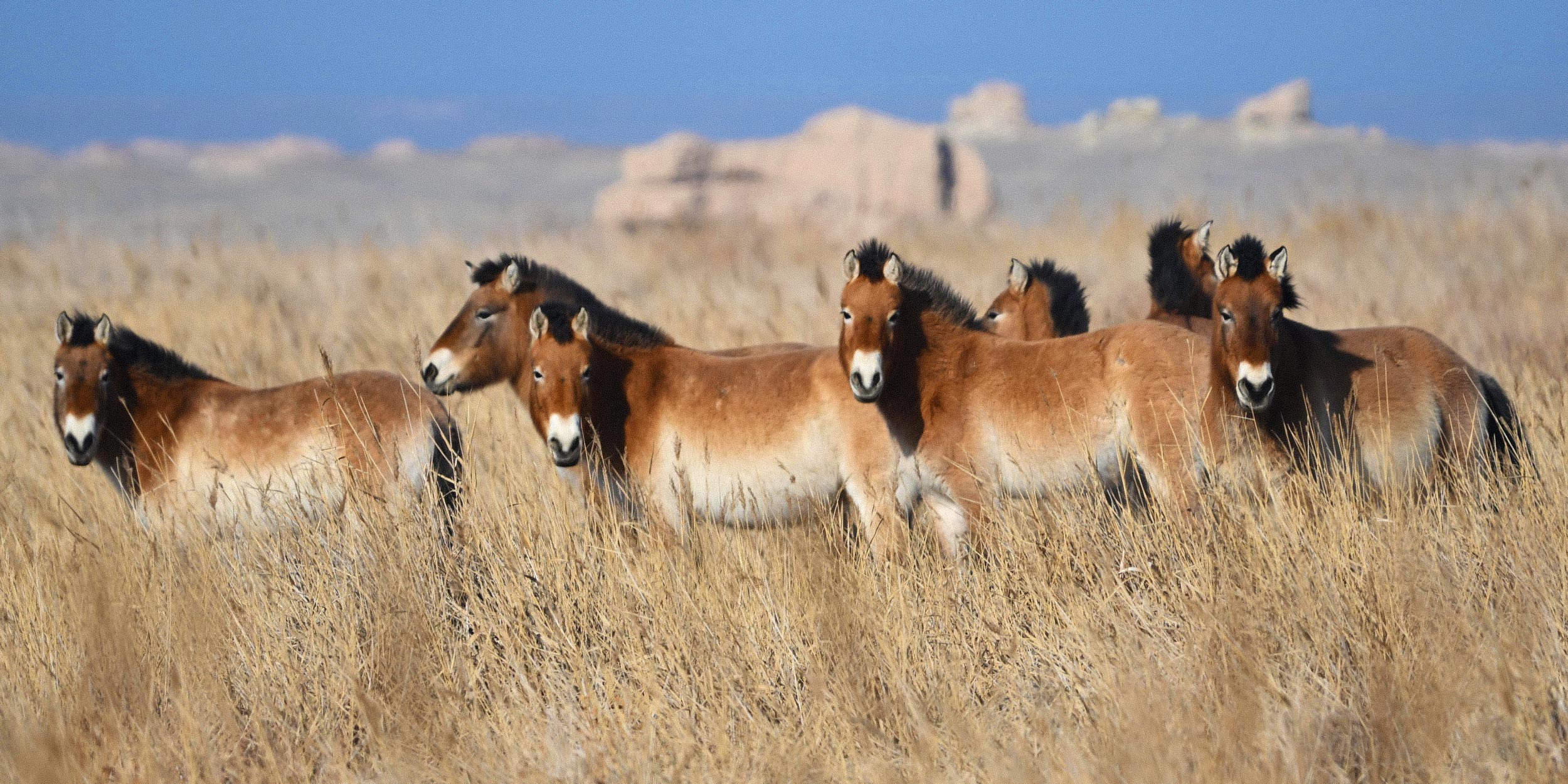
How China Successfully Reintroduced the World’s Last Wild Horses
This is the third article in a three-part series on the history of horses in China, which we’re running to usher in the Year of the Horse. Read Part 1 and Part 2.
Dawn has broken on the Year of the Horse — a zodiac animal whose history in China, and whose present-day image, largely revolves around domesticated horses. They are the elegant steeds in equestrian events and those galloping over the grasslands.
But China is also home to the last truly wild horses on earth — Przewalski’s horses. For millennia, these stocky, dun-colored animals roamed freely across the vast steppes and deserts of Central Asia, including what is now northwestern China. But by the mid-20th century, hunting and habitat loss had driven them to the edge. In 1969, following the last confirmed sighting by Mongolian biologists, the species was declared extinct in the wild.
Today, however, the silence of the steppe has been broken. After four decades of relentless conservation, China has successfully rebuilt its wild population to over 900 individuals — approximately one-third of the global total — establishing one of the world’s most successful large mammal reintroduction programs.
Rewind to the 1970s, and the wilderness of China and Mongolia held no trace of the Przewalski’s horse. The species’ survival hung by a thread, preserved only in European zoos. These captive herds were the descendants of just 12 wild individuals captured by European explorers in the late 19th and early 20th centuries. This tiny founder population created a severe genetic bottleneck, leaving the species vulnerable to inbreeding and low genetic diversity.
The turning point came in 1978, when the Foundation for the Preservation and Protection of the Przewalski Horse, based in the Netherlands, issued a call to reintroduce the species to its native habitat. China responded in 1985 with the “Wild Horse Homecoming” project, establishing the Xinjiang Wild Horse Breeding and Research Center on the edge of the Junggar Basin, a large steppe that was once part of the horse’s natural habitat. In December 1986, the first batch of 11 Przewalski’s horses arrived from the United Kingdom and Germany. Stepping out of trucks into the snowy landscape, they had returned home, but their journey was just beginning.
Under the meticulous care of the center’s staff, the horses gradually overcame challenges related to climate and diet, adapting to their ancestral environment. On March 8, 1988, a founding mare known as “German No. 2” gave birth to the first foal bred in captivity, named “Junggar No. 1.” This milestone proved that the Przewalski’s horses could not only survive in Xinjiang but were healthy enough to reproduce, reigniting the hope for their successful reintroduction on Chinese soil. Generations of foals have been born and raised in the center since.
But the true home for these wild horses was never the enclosure; it was the vast wilderness their ancestors once roamed. On Aug. 28, 2001, a historic moment unfolded at the Xinjiang Kalamaili Nature Reserve, which covers part of the Junggar Basin: 27 carefully selected horses, after a moment of hesitation on the edge of the vast Gobi, charged into their ancestral lands.
The initial release period presented severe trials, but they were guided by conservation staff. During winter, when temperatures plunged to minus 30 degrees Celsius, the herd faced starvation. Conservation teams drove jeeps through blizzards, scattering alfalfa to guide the horses to safety over three days. An even greater challenge was the reestablishment of natural social structures. Przewalski’s horses typically form harem groups (one male with several females) and bachelor bands. The restructuring of these social units can lead to infanticide and the elimination of old or weak individuals — a harsh yet natural law of the wild.
Hope solidified in the spring of 2003, when the released herd produced its first surviving wild-born foal. This signaled that the species could once again sustain itself without human intervention. Since then, releases have continued. By the end of 2024, the Kalamaili Reserve had released 18 batches totaling 146 horses, which have since organized into 27 wild herds. These populations are now self-sustaining: finding water in dry seasons, foraging autonomously, and mounting organized defenses against wolves. They now thrive alongside Mongolian wild asses, goitered gazelles, and argali sheep, restoring the region’s ecological vibrancy.
The recovery of the Przewalski’s horse is as much an ecological triumph as it is a scientific one. With every living individual descended from the same 12 ancestors, completely avoiding inbreeding is nearly impossible. However, scientific genetic management can, to a significant extent, mitigate the associated genetic defects. The Wild Horse Breeding Center collaborates with multiple research institutes on genome sequencing, establishing a database with each horse’s genetic profile. Through precise pedigree management and controlled breeding pairs, they work to reduce the probability that closely related horses will mate. This approach has allowed the population to successfully breed through six generations while maintaining an acceptable level of genetic diversity.
Cross-regional collaboration stands out as another highlight of the reintroduction and recovery effort. The Xinjiang center has helped other conservation efforts by providing them with breeding stock. In 2012, it exported four horses to Mongolia, which has also successfully built up a wild population, and it has transferred dozens of horses to programs in other Chinese regions. There the horses have succeeded in adapting to different landscapes — the wetlands and grasslands of Gansu’s Dunhuang Xihu Nature Reserve and the desert landscape of Ningxia’s Helan Mountains in the northwest, and the mountain steppe of Inner Mongolia’s Daqing Mountains in the north. These practices not only expand the species’ range but also help maintain genetic diversity through population dispersal, preventing genetic decline in isolated groups.
A complex monitoring system has also significantly contributed to the population’s health. Using watchtower-mounted cameras, drone patrols, GPS satellite collars, and infrared camera traps, Reserve staff can observe the real-time locations and behaviors of collared horses on a digital map. This technology can, for example, confirm that a horse is injured without staff needing to track down a herd in person, allowing for faster response times.
Today, the sound of the horses’ hooves echoes across the vast wilderness of Xinjiang, Gansu, Inner Mongolia, and Ningxia. From the reintroduction of 11 horses in 1985 to a total surpassing 900 by 2025, from artificial captivity to galloping across the wilderness of four provinces — this is a 40-year-long redemption of life.
(Header image: Przewalski’s horses in the West Lake Nature Reserve of Dunhuang, Gansu province, Jan. 8, 2026. Li Yalong/CNS/VCG)